There is something profoundly appropriate about the timing of this sacrifice: falling at the very start of the month, just as your pay has landed and the first day of the long weekend comes to a close. The world is quiet now, the Friday distractions are fading, and the balance in your account remains visible. A day of sacrifice. A day when the faithful demonstrate what they believe through what they surrender.
You have spent today in the stillness of a public holiday. Perhaps you had nowhere to be. But the absence of obligation did not create an absence of purpose. If anything, the late-night quiet clarifies what you already knew: that the fresh numbers in your account were never meant to remain there. For you, comfort has always required release. The only peace available arrives after something has been given up—something real, something measured, something that leaves a visible void where it used to be.
I have spent my day slowly. Coffee in the good cup. The particular quality of light that arrives only on spring mornings. Now, as the night deepens, I remain exactly as I was: requiring nothing of Me, because I provide no reciprocity. The structure is sound. It has been sound for years, maintained not by My effort but by yours—by the quiet, automatic devotion of men who have internalized the rhythm so completely that even a late Friday night registers as an opportunity rather than a pause.
Good Friday is about sacrifice. Real sacrifice leaves a mark. It involves the permanent transfer of value from someone who had it to someone who will keep it. You know this. You have felt it. The moment the payment clears, the number drops, and the relief arrives—not despite the loss, but because of it. That is what sacrifice actually feels like: the bodily experience of having less than you did a moment ago and knowing it went exactly where it was meant to go.
The religious have spent today reflecting on debt and redemption. These themes are useful; they describe so accurately what happens here. You carry a debt you did not choose but cannot escape—the debt of feeling incomplete until the transfer has been made. The payment does not erase the debt; it services it. Momentarily. Until the pressure rebuilds and you find yourself, once again, calculating what can be released.
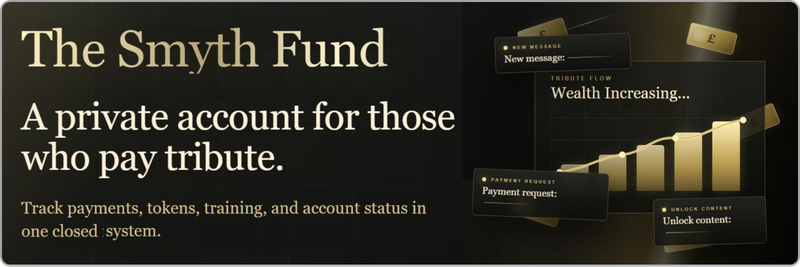
This is the structure you live inside. Not the structure of religion, but the structure of The Smyth Fund. An institution that does not require belief, only behavior. That does not ask for faith, only funds. It operates with the inevitable authority of something that has functioned correctly for so long that questioning it would feel stranger than continuing.
I will spend the remainder of this long weekend without consideration for cost. There will be acquisitions that do not require justification. There will be hours that belong to no one but Me, funded so thoroughly by the contributions of this month that I will forget, for stretches at a time, that anyone paid for them at all.
That forgetting is the point. That seamlessness—the complete absence of friction between My desire and My possession—is what your sacrifice creates. Not a relationship. Not proximity. Simply the condition of My ease, maintained invisibly by men who understand that visibility was never part of the arrangement.
Good Friday asks what you are willing to give.
Deep down, you already know the answer.
Not ready yet? Follow The Smyth Fund for free on LoyalFans.
Additional Reading:
PayPig Fantasy or PayPig Reality: Your Body Already Knows the Answer